
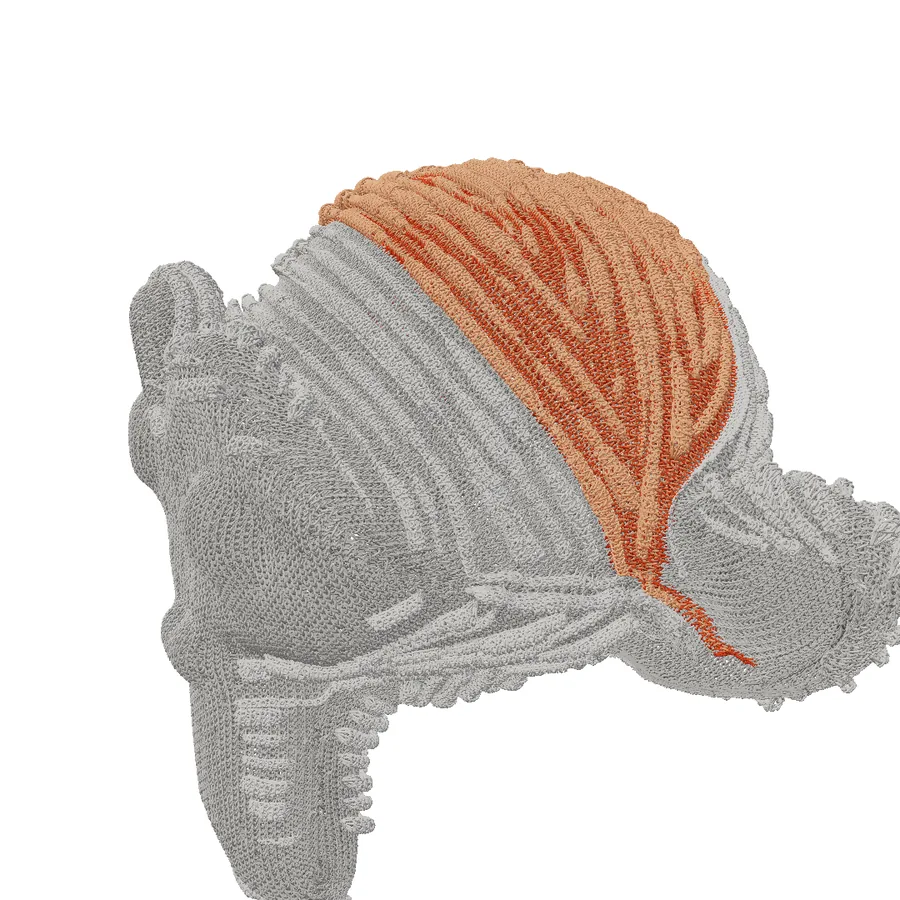
The crown
Courses 312–380 shorten toward the middle of the bed and widen again, twice over, turning back short of the ears. The top of the head gets rows its sides don't, so from the side they fan out over the crown, like the swatch's wedges.
Learn
A 3D knitting machine makes a shaped piece straight from one continuous yarn, one row of loops at a time. Nothing is cut from a sheet of fabric, so almost nothing is wasted. Here is how it works, step by step, with a monkey head designed in LOOP.
Knit along
Suzanne, Blender's monkey head, 16 cm ear to ear, in LOOP's Fabric view: 29,969 stitches on 145 needles over 682 courses, drawn from the real knit data. Every loop of yarn appears in the order the machine knits it.
01 · Starting knit
Knitmap
Off the machine
The machine doesn't knit a head that stands up on its own: Suzanne comes out of the needle bed as limp fabric, hanging from the needles, and takes her shape only on the form. LOOP's Fabric view shows both: it simulates the fabric hanging as the machine knits it, then wraps the finished piece onto the model.
01 · Out of the needle bed
The basics
Knitted fabric is one yarn pulled through itself, loop by loop, row after row. This is Suzanne's, up close in LOOP's Fabric view.
On the needles
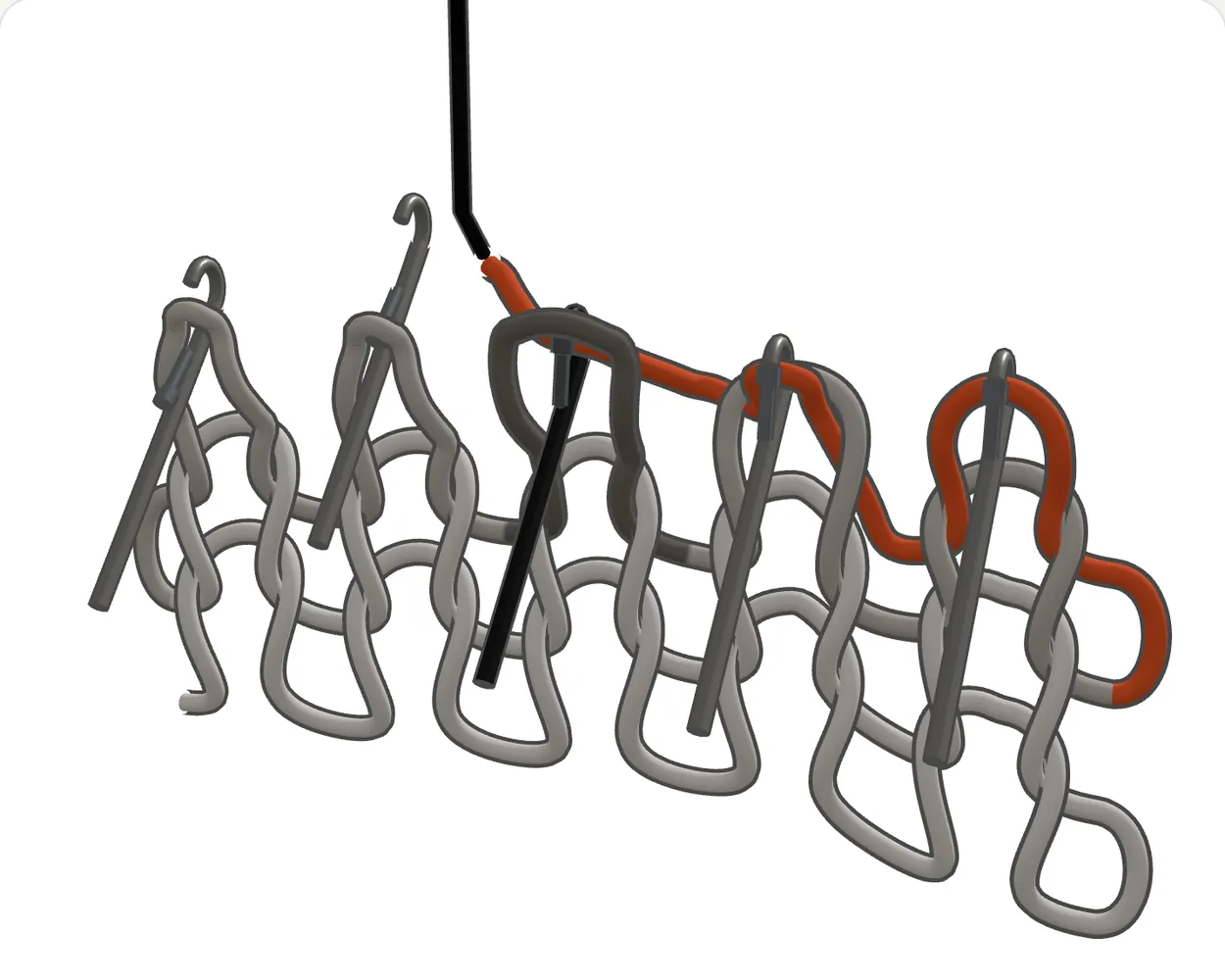
A flat knitting machine has two beds of latch needles: each needle is a hook with a small hinged latch. As the carriage passes, every needle in turn pulls a new loop through the one it holds. One pass, one course.
Shaping
A knitting machine's bed is straight, and it only ever knits rows. Curves come from short rows: courses that stop part of the way across and turn back, while the needles they skip hold their loops.
593 of Suzanne's 682 courses are short rows, and they set how long each wale runs: 386 loops down the middle of the face and over the crown, just 21 or 22 beside the ears. Here are three places they show, each course picked out in turn in two oranges, with its stretch of the knitmap below.
Courses 312–380 shorten toward the middle of the bed and widen again, twice over, turning back short of the ears. The top of the head gets rows its sides don't, so from the side they fan out over the crown, like the swatch's wedges.
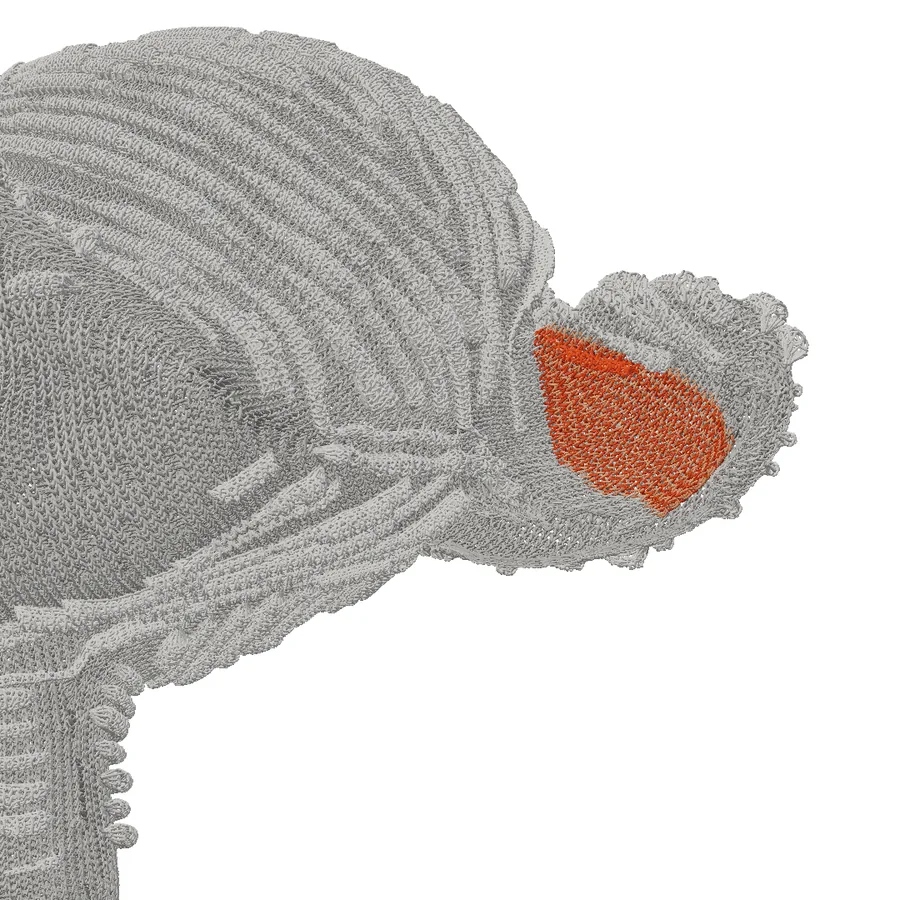
Each ear is a pocket of short rows at the edge of the bed: 24 courses on just 8 to 24 needles, while more than a hundred others hold their loops. Knitting back and forth over so few needles cups the fabric.
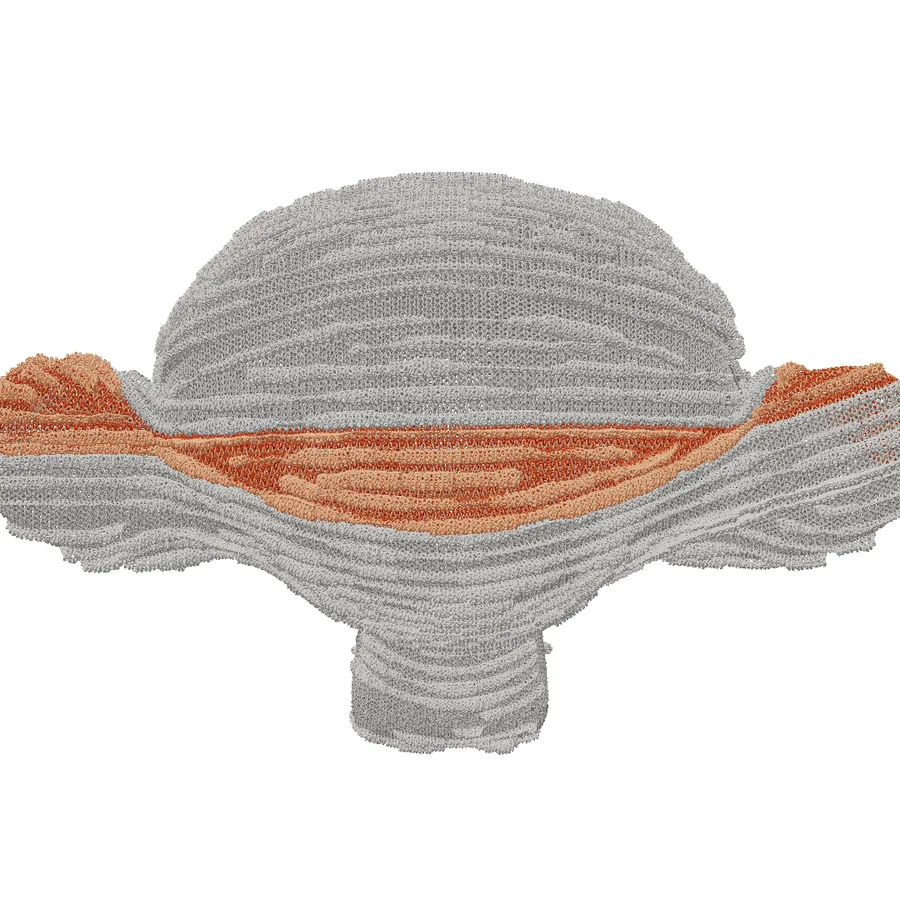
Courses 466–523 knit pockets of short rows at either edge of the bed, then shorten toward the middle and lengthen again. They knit a band that is deepest at the back of the head and rises behind each ear, curving it round.
Where LOOP comes in
Traditionally a specialist knit programmer plans every course in the machine maker's software. LOOP derives it from the 3D model.
01
Start from a 3D surface, an OBJ or .3dm file, and paint zones onto it. Suzanne has seven: face, eyes, nose, mouth and ears, each with its own knit structure.
02
LOOP lays courses and wales over the surface at the stitch density of the chosen structure, and decides where each course starts, turns and ends.
03
The stitches unroll onto the needle bed, every cast-on, short row and bind-off in place: 145 needles by 682 courses for Suzanne.
04
LOOP writes knit-ready machine data from the knitmap and replays it in the Fabric view, loop by loop, as in the video above. Production teams then validate it through prototyping.
Machine data
This is the .DAT file LOOP wrote for Suzanne: the program a Shima Seiki machine knits her from. Each row is one pass of the carriage and each column one needle, every colour an instruction: knit, tuck, transfer. The columns down the sides set the carriage's speed, the yarn carriers and more. Beside it, the same program as text: LOOP's knitcode, course by course, and knitout, the open format for knitting machines. Like any program, it is proved on a prototype before production.
All
Loading…
Drag to look around, pinch or Ctrl-scroll to zoom, and hover or tap a cell to read it; the text follows.
Your turn
Bring a 3D model. LOOP plans every course, from cast-on to bind-off.